

Why Choose Us?
Anhui Liyuan Wire Drawing Dies Co, Ltd. is the industry's leading manufacturer and supplier of wire drawing dies, SSCD wire drawing dies, ND wire drawing dies, special-shaped dies and other products. Our product range is wide and includes the following derivative products: wires and cables, electrical alloys, magnet wires, tungsten wires, molybdenum wires, etc. At present, we have introduced professional production and testing equipment from the Norwegian "CONOPTLCA" and the German "SCOB" companies. We ensure that the production and quality inspection processes of all products are strictly in accordance with IS09002 standards.
Rich Products
Our products are rich in variety and can be used to pull out various metal materials with specifications ranging from 0.01mm to 6.0mm, which can be used in copper wires, alloy copper wires, copper carbon wires and various coated wires.
Professional Service
Our team has many years of export experience and can provide comprehensive product consultation, transportation tracking and warranty services. If we have any issues within one year from the date of purchase, we will respond quickly and cover the shipping costs and send a replacement.
Quality Certification
Our company strictly controls product specifications and quality during the production process, and produces in accordance with IS09002 standards.
No.1 Sales Volume
Our company is China's largest wire drawing die export factory and has introduced imported production and inspection equipment, supporting mass ordering and customized services.


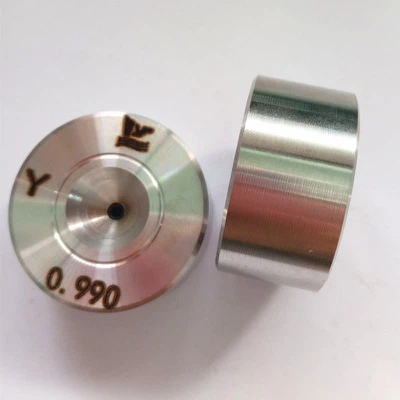
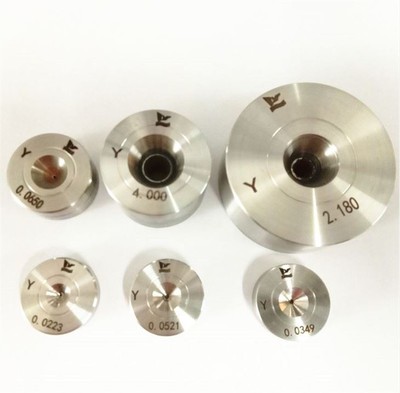
Usually refers to all kinds of dies for drawing metal wires and wire drawing dies for drawing optical fibers. All wire drawing dies have a hole in the center of the die of a certain shape, round, square, octagonal, or another special shape. The metal is drawn through the hole in the die to become smaller and even change shape. A steel die is sufficient for soft metals (e.g., gold and silver), which can have several holes of different diameters.
Wire drawing die is widely used, such as electronic devices, radar, television, instrumentation, and aerospace. Other high-precision wires used in tungsten wire, molybdenum wire, stainless steel wire, wire, cable wire, and a variety of alloy wires are commonly used with diamond wire drawing die drawing out of the diamond wire drawing die due to the use of natural diamond as a raw material, which has strong abrasion resistance, the service life of a very high.
Base type
Pulling soft metals (such as gold and silver) when the steel mold is enough, the steel mold can have several different apertures on the hole.
Tungsten carbide mold - pulling steel wire (steel wire) generally uses tungsten carbide mold (Tungsten carbide nib); the typical structure of this mold is a cylindrical (or slightly tapered) tungsten carbide die core closely set in a round steel set (case), the core hole in the trumpet (Bell radius), entrance cone (Entrance angel), deformation (work) cone (Bell radius), the entrance cone (Entrance angel), deformation (work) cone (approach angle), sizing band (bearing) and exit angle (back relief).
Steel wire dies - pull non-ferrous metal wire, such as copper, aluminum, and more steel wire die similar to the wire drawing die, with some differences in the shape of the inner hole.
Polycrystalline die - pull fine wire available to the polycrystalline die (artificial diamond), also used in natural diamond wire drawing die.

What is Wire Drawing Dies?
Wire drawing dies are precision tools used to produce round or shaped wire to very tight tolerances. Wire drawing is a cold plastic deformation process by which the diameter of a rod or a wire is reduced and its length is increased by pulling the workpiece through a calibrated hole of a conical die. The deformation and elongation of wire material takes place within the profile of the wire drawing die, which are characterized by high strength because of strain hardening.
Features of Wire Drawing Dies
Wear Resistant
Our metal wire drawing dies are made of different materials, including tungsten carbide, diamond and carbide, and are hardened to keep hardness and wear resistance.
Smooth Surface
These drawing dies are polished and ground during production, with smooth and high-gloss surfaces, and maintain little adhesion to the metal being processed during the drawing process.
High Thermal Conductivity
They conduct heat well to keep the temperature of the metal being processed uniform during the drawing process.
Corrosion Resistance
The powder coating added to the surface of our drawing dies can resist wear caused by other metals and friction during wet lubrication drawing, especially acid lubrication drawing.
Applications of Wire Drawing Dies

Plastic Industry
Metal wire drawing is used to preprocess standard parts. When wire drawing is used in the plastics industry, polyester, nylon, polyethylene, polypropylene, polyester chips, etc. are used as raw materials to produce a series of complete sets of hollow, solid round or flat wires.
Electrical Industry
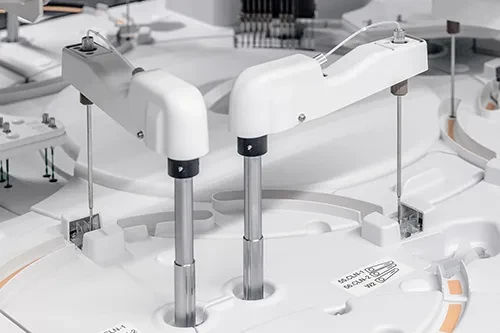
Wire drawing is used to produce copper and aluminum wires and cables of varying diameters, and wire drawing produces spokes for wheels, springs and other components, enabling the production of wire with precise diameters and tolerances.

Auto Industry
Wire drawing is used to produce large lengths of small sections. Various applications include tension loaded structural components, paper clips, coil springs, small diameter rods and tubes, jewelry and stringed instruments. The benefit is the ability to produce wire in a variety of materials, including aluminum, copper and steel. This allows manufacturers to produce wires suitable for a variety of applications.
Types of Wire Drawing Dies
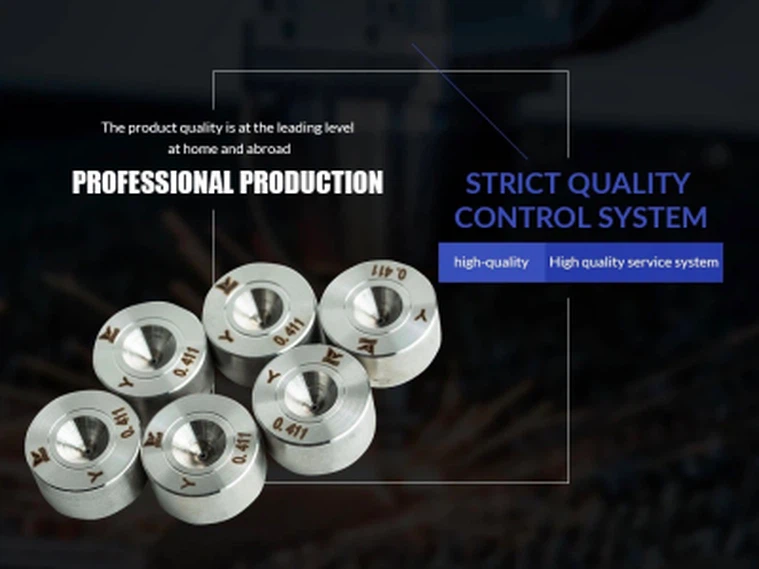
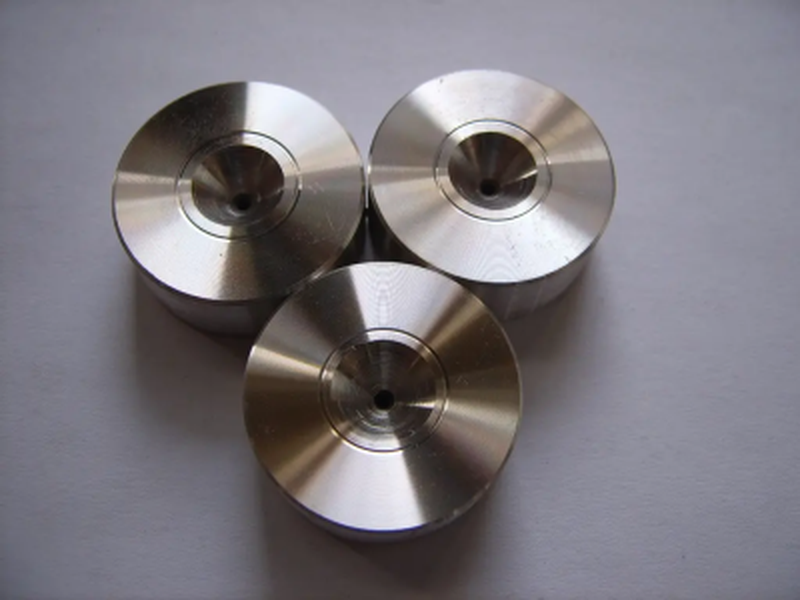
Diamond Drawing Dies
Single Crystal Diamond Dies
A single crystal diamond drawing dies using a single crystal diamond having high thermal conductivity is used for a wide range of applications such as copper wire and stainless steel wire for its high quality and long life. In particular, it is suitable for processing that requires ultrafine wire drawing and high quality surface roughness.
Polycrystalline Diamond Dies
For a Polycrystalline diamond drawing dies, sintered diamond powder obtained by ultra-high pressure is used. Although the target material is the same as that of a single crystal diamond drawing dies, it can be applied to a wide range of applications from large diameter wire to thin wire because it can be applied to larger sizes.
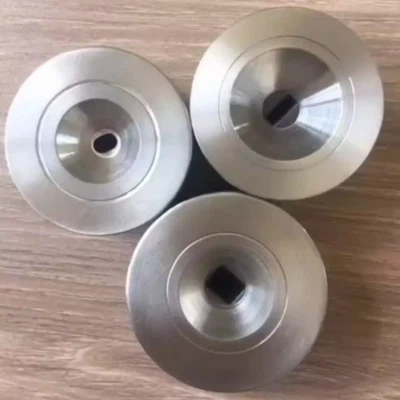
Shaped Wire Drawing Dies
The cross sectional area provides a heteromorphic shape other than a circle. It is used for manufacturing various heterogeneous wires – from windings of transformers in the heavy electric industry to connector pins and flat cables used in general electric machinery to accessories such as chains of necklace.
Compacting Dies: A compacting dies is a tool that compresses circularly while twisting conductors (wires), used for power cables and low voltage electric wires (wire harnesses) for cars.
Shaving Dies: A shaving dies is a tool that removes oil, oxides, bubbles, scratches on the surface after wire drawing. It is a diamond die that scrapes off the wire surface using the diamond's inner peripheral blade.
They are the early type of wire drawing dies. The main materials to make nibs of alloy steel wire drawing dies are carbon tools steel, and alloy tool steel. This kind of wire drawing dies almost disappeared because of poor hardness and wear resistance.
These dies are made of tungsten carbide. The main components are tungsten carbide powder and cobalt powder. Tungsten carbide is the main factor behind high hardness, and cobalt is bonded metal to bind tungsten carbide particles tightly and it is a source of alloy toughness.
Design of Wire Drawing Dies

Steel Case
The casing should be made of good quality steel with a hardness of 20 to 25 Rock-well c. The outside diameter should be concentric with the inside bore and square with the face to produce consistent die geometry. The inside bore should be precision machined to a close tolerance to ensure a correct press fit with the carbide nib. Without the proper press fit, higher tensile material can crack the nib causing a catastrophic failure of the die.
Bell Radius
The bell radius incoming rod entering a wire drawing die on a spiral path, such as paying off into a bull block or ripper die. As rod or wire should enter a die as straight as possible to prevent uneven stress on the material. It should contact this surface only for a moment before becoming centered into the approach zone. The bell can be left rough cord as supplied by die manufacturers, and any polishing of the bell is only for cosmetic appearance because no drawing should ever take place here.
Entrance Angle
The function of the entrance angle is to direct the flow of lubricant into the working zone of a die. As with the bell radius, it can be left unpolished. the normal entrance angle is a 40 degree included angle in standard R5 series wire dies.

Approach Zone
The approach zone is the most important section of a wire drawing dies. Reduction in area and lubrication of the incoming wire surface occur here. The efficiency of any die is determined by the design and accuracy of this approach zone, which must be cut to an accurate conical angle with a smooth surface finish. sides of the approach zone must be straight without a distinct radius or blended contour along its entire surface. the angle must be precision-machined to ensure the angle and die surface have a common centerline. in addition, these surface must be concentric with the outside diameter of the steel case to prevent out-of-round wire. the normal angle used in wiredrawing are usually between 8-20 degree included angle.

Bearing
The function of the bearing is to control the final diameter of the drawn wire, guarantee its roundness and straightness, and produce a flat, smooth surface finish. For these reasons, the round, parallel surface must be machined to a close dimensional tolerance to produce quality wire. length of the parallel bearing surface should be form 25-50 % of the diameter to prevent the die from rapidly wearing oversize, the bearing length selected depends on hardness of the drawn wire and desired lubricant film, typically, harder materials use shorter bearing lengths, such as 25% or 35%, to prevent heat buildup that can cause lubrication failure. Softer materials can use bearing lengths of up to 50%, which maintain final wire size for a longer time.

Back Relief
the back relief is a conical angle designed to strengthen the exit of the wire drawing dies and prevent nib breakage. it also keeps the metal forming area centered in the nib since its length positions the bearing and approach angle higher in the nib. the back relief angle is usually preformed in a rough cord die with an included angle from 30 to 90 degrees.

Meeting Point
The meeting point diameter is where the approach angle meets the back relief angle before the final diameter and bearing are machined in the die. The approach angle generally is machined in an internal die grinder with a diamond pin to enlarge the angle to the desired meeting point diameter. Meeting point diameter is a function of the approach angle, the bearing length, as a percent of the final diameter, and the back relief angle.
Preparation of Wires
Before pulling the wire, preparations must be made. This includes cleaning the wire to remove dirt or impurities and using lubricants to reduce friction during the drawing process. Initially, the rods used for wire drawing are pickled in acid to eliminate any scale buildup and then electrically butt welded. Iron hydroxide, copper or tin coatings can be applied to the rods during or after the pickling process. Large hot-rolled coils with a diameter of about 10 mm need to be pre-treated before actual wire drawing. Steel wire pre-treatment includes:
Clean: This may involve pickling, rinsing, drying the coils or mechanical bending.
Neutralize: The ingredients are then immersed in a lime bath to neutralize any remaining acid.
Pointing Wire
The end of the wire must be pointed so that it can be easily inserted into the mold. This is usually done using a wire mill or manually using a file
Completed.
Pull the Thread
The wire passes through the first die and is pulled by a powerful motor or winch. As the wire is pulled through the die, its diameter decreases and its length increases. The process is repeated through a series of dies until the desired diameter is achieved.
Annealing
As the wire is pulled, it becomes harder and stronger. It may also become more brittle. In some cases, the wire may need to be annealed to relieve stress and strain caused by the drawing process. Annealing is heating it to a specific temperature and then slowly cooling or quenching it at room temperature. The wire is annealed to soften the metal and make it more ductile for further drawing or manufacturing steps. The annealing process reduces the strength of the wire, but makes it less brittle.


Completion and Final Steps
Depending on the application, wire diameters range from a few tenths of a millimeter to several millimeters. Wire properties, such as strength, conductivity and hardness, can be customized based on the specifics of the starting material and drawing process. Once the wire is drawn to its final diameter, it may undergo additional finishing processes, such as coating or plating, to enhance its performance or appearance. The wire then undergoes final cleaning, cutting and packaging for sale and distribution. To prevent rust, some wires may receive additional treatments, such as galvanizing. The wire can be sold as-spooled or fed as input to another production line.
What You Should Know When Use Wire Drawing Dies?
Die Inspection: The inspection is done to determine the amount of wear in the die and to decide what action needs to be taken: keep working with the dies, or send them to the die shop for repair. A maintenance schedule should be prepared where the dies are removed from the machine at every scheduled period for inspection and, if necessary, sent for refurbishing. Die inspection is typically performed with either a binocular or monocular microscope. Check here for microscope and magnification recommendations.
Inspection Criteria: Depending on the final use of the wire and its specifications, the criteria for die inspection will vary.
The decision to remove dies from the machine can be made because:
the diameter of the wire is out of tolerance
the wire surface quality is deteriorating (less/more shiny/mat, scratched, etc.)
the ovality of the wire is too big
a wire shaving effect appears
wire breaks happen more often than normal
Drawing Ring: The wire begins its reduction and elongation in the reduction angle of the die. At that point the wire is in contact with the surface of the diamond and a wear ring is created over time. This drawing ring gets deeper and wider as more wire is drawn through the die.
The appearance of the drawing ring may change due to the material drawn and the length of time that the die is used. Different reductions will also create different positions of the ring in the reduction angle.
Lines, Scratches: Lines are an indication of heavy or excessive wear in the die. They are created by the wire being drawn through the die. Lines usually start at the drawing ring and are drawn towards the bearing, along the reduction angle. Once the lines reach the bearing and are drawn into the bearing, the surface of the wire quickly deteriorates and the size increases rapidly.
Cracks and Particle Pullout: It is not always possible to see a crack during visual inspection because the drawing ring can hide it. Once the die surface is “cleaned” of the drawing ring and other defects, the crack becomes visible.
Generally, when the crack is located between the drawing ring and the bearing zone, the die is considered broken or scrap. When the crack is above the drawing ring, the die may be recut because the crack is not in the working area of the die
Repolishing: Repolishing of a die consists of removing the defects caused by wire being drawn through the reduction angle. Repolishing is possible when the drawing ring is not too deep and the bearing area is not damaged. In other words, repolishing is possible on dies with slight wear.Repolishing is accomplished by grinding a needle to the nominal reduction angle of the die. This needle is then used to repolish the die on an ultrasonic polishing machine together with diamond powder.
As the bearing length may shorten during this operation, after repolishing the reduction angle for a few times, we recommend the full refurbishment of the die in order to recreate the original geometry.
Recutting: Recutting or sometimes called refurbishing or reboring of the die, removes all the defects generated by the passing of the wire through the die’s geometry.
With recutting it is possible to remove the drawing ring as well as the scratches and defects that appear both in the conical and cylindrical part of the die.
Certificate Photo

Our Factory Photo

Frequently Asked Questions of Wire Drawing Dies
Q: What is the purpose of wire drawing?
Q: What is the effect of die angle in wire drawing?
Q: What is pressure die in wire drawing?
Q: What are the disadvantages of wire drawing?
Q: What are the wear of wire drawing?
Q: What are the uses of drawing dies?
Q: What materials are used to make wire drawing dies?
Q: What is the process of aluminum wire drawing?
Q: What are some common shapes of wire drawing dies?
Q: Is wire drawing cold working?
Q: What is the difference between a diamond wire drawing die and a tungsten carbide wire drawing die?
Q: How are wire drawing dies maintained?
Q: What are the factors that affect the lifespan of a wire drawing die?
Q: What is high pressure die?
Q: What are some common wire drawing defects and how are they prevented?
Q: How are wire drawing dies used in the manufacturing industry?
Q: What are the advantages of using wire drawing dies?
Q: What are the wire made of?
Q: What is the working process of wire drawing as compared with extrusion?
Q: What are the safety precautions when using wire drawing dies?
We're well-known as one of the leading wire drawing dies manufacturers and suppliers in China. Please rest assured to wholesale high quality wire drawing dies at competitive price from our factory. Contact us for customized service.
