

Why Choose Us?
Anhui Liyuan Wire Drawing Dies Co, Ltd. is the industry's leading manufacturer and supplier of wire drawing dies, SSCD wire drawing dies, ND wire drawing dies, special-shaped dies and other products. Our product range is wide and includes the following derivative products: wires and cables, electrical alloys, magnet wires, tungsten wires, molybdenum wires, etc. At present, we have introduced professional production and testing equipment from the Norwegian "CONOPTLCA" and the German "SCOB" companies. We ensure that the production and quality inspection processes of all products are strictly in accordance with IS09002 standards.
Rich Products
Our products are rich in variety and can be used to pull out various metal materials with specifications ranging from 0.01mm to 6.0mm, which can be used in copper wires, alloy copper wires, copper carbon wires and various coated wires.
Professional Service
Our team has many years of export experience and can provide comprehensive product consultation, transportation tracking and warranty services. If we have any issues within one year from the date of purchase, we will respond quickly and cover the shipping costs and send a replacement.
Quality Certification
Our company strictly controls product specifications and quality during the production process, and produces in accordance with IS09002 standards.
No.1 Sales Volume
Our company is China's largest wire drawing die export factory and has introduced imported production and inspection equipment, supporting mass ordering and customized services.

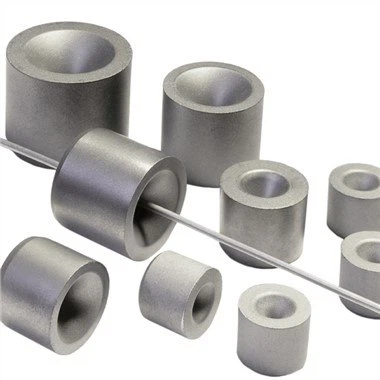
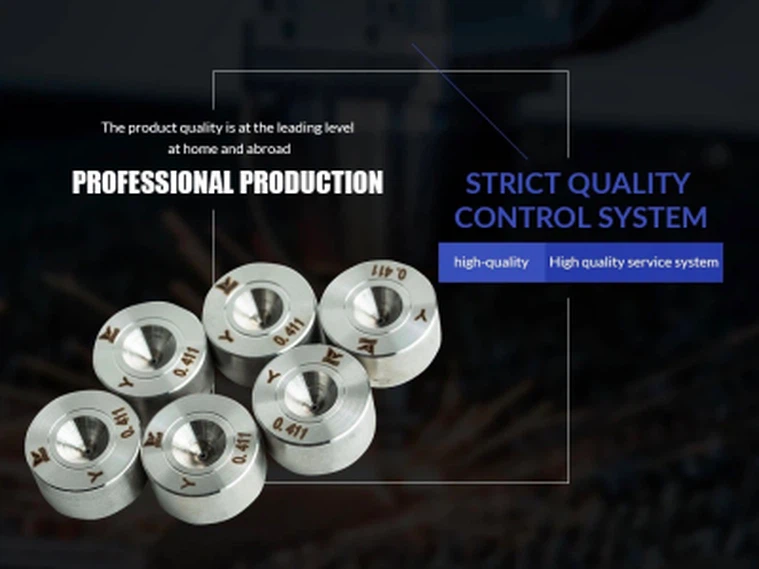
Tungsten carbide wire drawing die is the tool that enables a wire manufacturer to decrease the diameter of a bar or coil stock during the manufacturing process. Tungsten carbide wire drawing dies are superior to other materials in terms of wear resistance, corrosion resistance and heat exchange capability. This makes them suitable for a range of applications including electronics assembly, auto parts production and oil production industries. Heat transfer accuracy and dimensional shrinkage are also important considerations when selecting the right tungsten carbide wire drawing die for your application. Additionally, tungsten carbide provides better surface finishes than other materials as it’s harder wearing which reduces fiber deformation at higher speeds (wire drawing).

What is Tungsten Carbide Wire Drawing Die?
Tungsten Carbide dies are little, ultra-hard precision tool with a small hole at its center, that reduce the diameter of wire. They are also known as draw dies or extrusion dies, for use in making wire, rods, pipe and bars in all standard shapes-round, hexagonal and rectangle. These dies can serve drawing of various materials including Mild Steel, High-Carbon steel, Stainless Steel, as well as numerous other steel alloys. Softer materials like aluminum and copper alloys can also be frequently drawn.
Features of Tungsten Carbide Wire Drawing Die
Various Specifications
Our tungsten carbide wire drawing dies are available in various shapes and sizes and can be customized according to customer needs.
Durable
The composition of these tungsten carbide wire drawing dies contains tungsten and carbon components, forming an extremely dense crystal structure, giving it a Mohs hardness of "9", second only to diamond, so it is not easy to break.
Anti-Oxidation
These molds can withstand high temperatures when in use, oxidizing only at about 300°C and reacting rapidly at about 700°C to form oxide (WO₃).
High Precision
Our tungsten carbide wire drawing dies are made through melting, sintering and cooling processes to have uniform size and appearance, maintaining accuracy when producing precision parts.
Applications of Tungsten Carbide Wire Drawing Die
Wire Drawing
Tungsten carbide wire drawing die is utilised to produce wires used in electrical industries made from materials like copper and aluminium. Products like paper clips and helical springs are manufactured using the Metal drawing process.
Rod and Tube Drawing
Small diameter rods and tubes are also obtained through Metal drawing. The process enables the production of long pieces with small cross-sectional areas, creating small diameter rods and tubes for various applications.
Spring Manufacturing
The die is used to produce helical springs, which find use in various mechanical and industrial applications. Or it is employed to manufacture various fasteners like screws, bolts, and nails.
Precision Components
Tungsten carbide wire drawing die is used to produce precise and intricate components for industries such as automotive and aerospace.
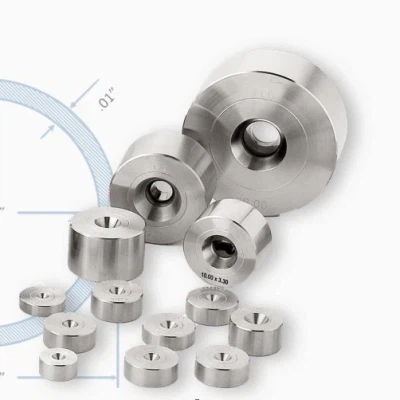
Structure of Tungsten Carbide Wire Drawing Die
Entrance
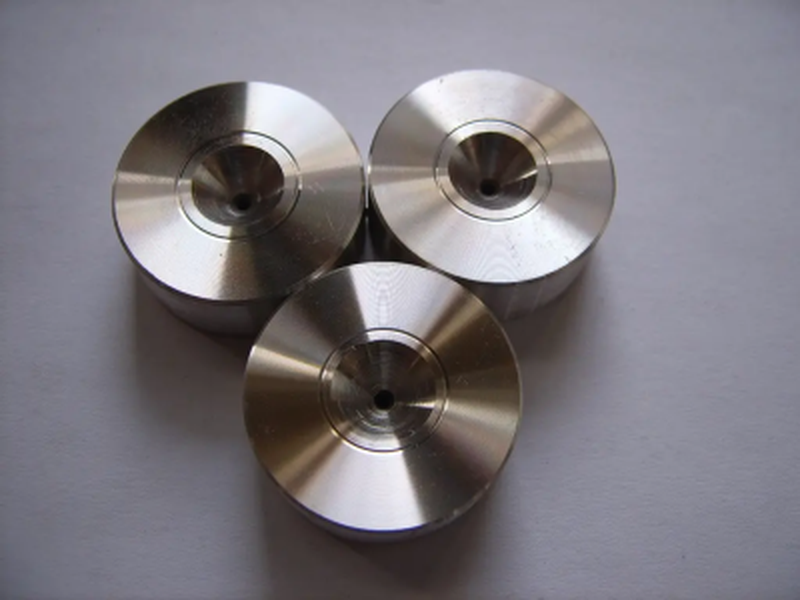
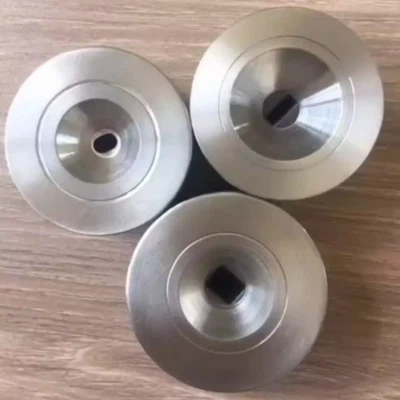
The structure of the entrance is conical in shape and is the largest part of the die-hole cross-section. Generally, the entrance with an angle of 30~35° or R=3.5~6 in order to facilitate the entry of the embryo into the die-hole. The full entry of the lubricant into the die cavity, and ensure that the material is not scratched by the entrance of the die hole.
Reduction Angle
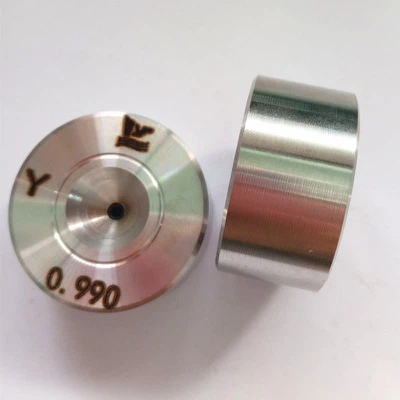
The reduction angle is also called the compression area, or deformation area. It is the most important part of the whole die-hole, its function is to make the metal plastic deformation here, the angle and height of the working area are two important parameters of the stretching die.
The choice of a correct reduction angle is related to the compression rate of the road, the tensile strength of the drawn metal, and the friction coefficient when stretching. When the compression rate increases, the correct reduction angle should be increased. The higher the tensile strength of the drawn metal, the lower the reasonable working angle should be.
The height of the education angle is generally 2.5~3 times the height of the actual deformation zone of the wire. If the reduction angle is too short for the storage of lubricant. It will cause the deterioration of lubrication. The working area is too long, which is bound to cause the waste of material and increase the cost.
Because of this kind of wire drawing die work area, sizing area vertical cross-section contour line are straight, domestic generally called its “linear” hole type of drawing die. The actual deformation length of the wire in the work area reaches more than 50% of the work area height.
Bearing Length
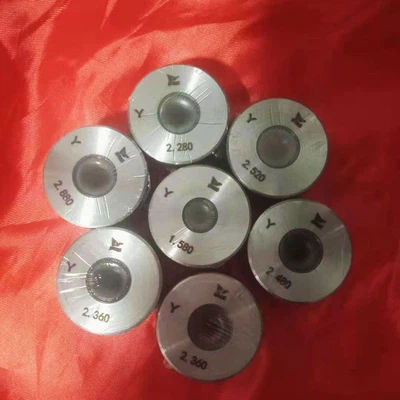
The bearing length is the most suitable shape is cylindrical, the role of the wire is to further obtain and stabilize the precise shape of each size. It can make the drawing die to ensure the accuracy of the drawing wire size and prolong the lifespan of the drawing die. The drawing die must have a straight section of the sizing zone whose height is 0.35-0.5 times the diameter of the hole (hole diameter of 12mm or less). Considering the elastic deformation of the wire and the drawing direction may not be in a straight line with the center of the drawing die and scratch the wire, affecting the surface finish of the wire and the life of the drawing die.
Generally, we should make the sizing area and the exit area of the connection to eliminate the edge, the height of 0.3 ~ 0.8mm is appropriate, and the angle should be 5 ~ 8°.
Exit
The role of the exit area is to prevent the wire from being scratched when pulling out of the die hole and to protect the sizing area from being pulled apart when drawing. The shape is generally conical, with a cone angle of 30~35°, and its height is generally 0.2~0.5 of the diameter of the die hole.
Tungsten Carbide Die Processing
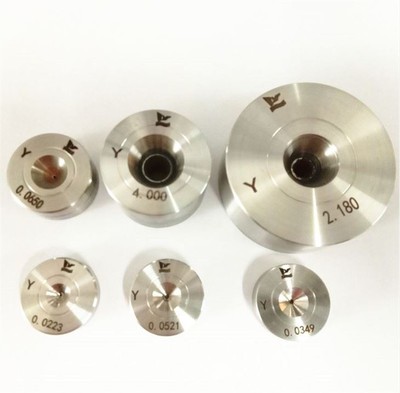
The core of the hard alloy drawing die will shrink in the sintering process, and the shrinkage of different batches is also different due to the difference of composition, pressing and sintering process. Due to the different shrinkage of the die parts, the shape of "saddle" or "bell mouth" is often formed. Therefore, the die must be grinded in the outer circle, which requires special fixture on the grinder and grinding with diamond grinding wheel.
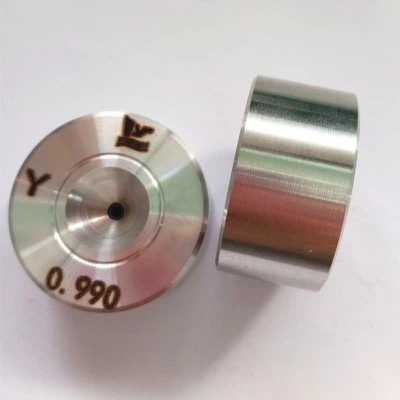
Interference Amount
The diameter of the inner hole of the mold sleeve should be smaller than the outer diameter of the mold core in order to obtain a certain prestress during insertion, and the difference between the two is called interference. Interference should be determined according to die core size and deviation, drawing stress and insert method. Die set is inlaid with hot pressing method and cold pressing method two kinds, cold pressing method interference is small, the pre-compression stress is also small, used for manufacturing small specifications, soft metal drawing die.
Tungsten Carbidemold Sleeve Processing
The mold sleeve is formed by turning on a lathe. The control points are as follows:
(I) The inner diameter roughness of the mold sleeve must reach 0.80 i. 6m, which is conducive to close fit with the mold sleeve;
(2) The inner diameter of the mold sleeve should correspond to the outer diameter of the mold blank one by one to ensure the accurate interference amount of each mold;
(3) The bottom surface of the inner hole of the mold sleeve and the outer end of the mold must be parallel, and ensure that the center line of the mold hole is vertical after the sleeve is installed;
(4) The ellipticity of the inner hole of the mold sleeve should be as small as possible, not more than 0.02mm. During hot loading, the outer surface of the mold cover should be illuminated, and uniform cooling should be ensured after mounting.


Mounting Technology
The cold pressing process is to press the blank into the mold sleeve at room temperature. Cold pressing method requires accurate interference and high dimensional accuracy of mold core and mold sleeve.
What You Should Know When Use Tungsten Carbide Wire Drawing Die?
According to the physical and mechanical properties of the drawn material and the size of the material, a reasonable choice of cemented carbide drawing dies grades.
Check whether the drawing machine is stable before drawing, and there must be no vibration phenomenon, otherwise, the drawing die may be easily damaged.
The surface of the wire must be properly cleaned and dried before drawing, otherwise, it will easily reduce the service life of the mold, and the surface of the wire may also cause scratches and affect the surface finish.
For wires with excessive hardness or uneven hardness, it should be hardness reduced by annealing or tempering, and elongated to maintain good hardness uniformity.
Select a lubricant with excellent lubrication performance, such as wire drawing lubricant powder, etc., to maximize the lifespan of the drawing dies. Use a lubricant to carry out good cooling, reduce friction and do a good job of lubrication in the working area, especially when drawing at high speed, it makes great help.
Choose the appropriate compression rate according to the size and performance of the drawn wire. If the compression rate is too small, it will increase the production cost. If too high, it will reduce the life of the mold and even result in a mold breakage. For example, the single-face shrinkage rate is generally not more than 20% for drawing stainless steel wire.
During the drawing process, if it is found that the metal particles adhere to the inner hole of the core, and the scratches are formed on the surface of the metal material, we should stop drawing immediately, remove the adhered metal particles, and polish the inner hole.
Anti-rust oil should be used to protect the temporarily unused TC drawing dies.
Certificate Photo

Our Factory Photo

FAQ of Tungsten Carbide Wire Drawing Die
Q: Why we use tungsten carbide drawing die?
Q: What is the composition of tungsten carbide drawing die?
Q: What is the purpose of tungsten carbide drawing die?
Q: How is tungsten carbide drawing die made?
Q: What is the importance of tungsten carbide drawing die in the manufacturing industry?
Q: What are the advantages of using tungsten carbide drawing die?
Q: What are the disadvantages of using tungsten carbide drawing die?
Q: How tough is tungsten carbide?
Q: Is tungsten carbide easy to break?
Q: Why is tungsten carbide so cheap?
Q: How long does a tungsten carbide drawing die last?
Q: What is so special about tungsten carbide?
Q: What factors affect the lifespan of a tungsten carbide drawing die?
Q: How often should tungsten carbide drawing die be maintained?
Q: What is the temperature range for using tungsten carbide drawing die?
Q: What is the ideal pressure range for using tungsten carbide drawing die?
Q: How does the size of the wire affect the use of tungsten carbide drawing die?
Large or medium diameter wires: 60 degree exit cone angle
Small diameter wires: 75 or 90 degree exit cone angle, or hemispherical shape
Q: How Should I Protect Tungsten Carbide Wire Drawing Dies?
Good lubrication
Reasonable allotype
Appropriate adjustment of the size
Q: What are the common applications of tungsten carbide drawing die?
Q: What is the role of lubrication in using tungsten carbide drawing die?
We're well-known as one of the leading tungsten carbide wire drawing die manufacturers and suppliers in China. Please rest assured to wholesale high quality tungsten carbide wire drawing die at competitive price from our factory. Contact us for customized service.
