

Why Choose Us?
Anhui Liyuan Wire Drawing Dies Co, Ltd. is the industry's leading manufacturer and supplier of wire drawing dies, SSCD wire drawing dies, ND wire drawing dies, special-shaped dies and other products. Our product range is wide and includes the following derivative products: wires and cables, electrical alloys, magnet wires, tungsten wires, molybdenum wires, etc. At present, we have introduced professional production and testing equipment from the Norwegian "CONOPTLCA" and the German "SCOB" companies. We ensure that the production and quality inspection processes of all products are strictly in accordance with IS09002 standards.
Rich Products
Our products are rich in variety and can be used to pull out various metal materials with specifications ranging from 0.01mm to 6.0mm, which can be used in copper wires, alloy copper wires, copper carbon wires and various coated wires.
Professional Service
Our team has many years of export experience and can provide comprehensive product consultation, transportation tracking and warranty services. If we have any issues within one year from the date of purchase, we will respond quickly and cover the shipping costs and send a replacement.
Quality Certification
Our company strictly controls product specifications and quality during the production process, and produces in accordance with IS09002 standards.
No.1 Sales Volume
Our company is China's largest wire drawing die export factory and has introduced imported production and inspection equipment, supporting mass ordering and customized services.


Diamond wire drawing dies are tools that are used to reduce the diameter of wire by pulling it through a hole that gradually decreases in size. The dies are made from diamonds, which are known for their exceptional hardness and wear resistance. This makes them suitable for use in high-volume wire drawing operations, where they can produce wire with a high degree of surface finish and consistency in diameter.
Diamond wire drawing dies are commonly used in the production of wire for electrical conductors and cables, as well as in the manufacturing of mechanical components. They are also resistant to heat and chemical attack, making them suitable for use in a wide range of manufacturing environments.
In addition to their durability and precision, diamond wire drawing dies also have a longer lifespan than other types of wire drawing dies, making them a cost-effective choice for many manufacturers.

What is Diamond Wire Drawing Dies?
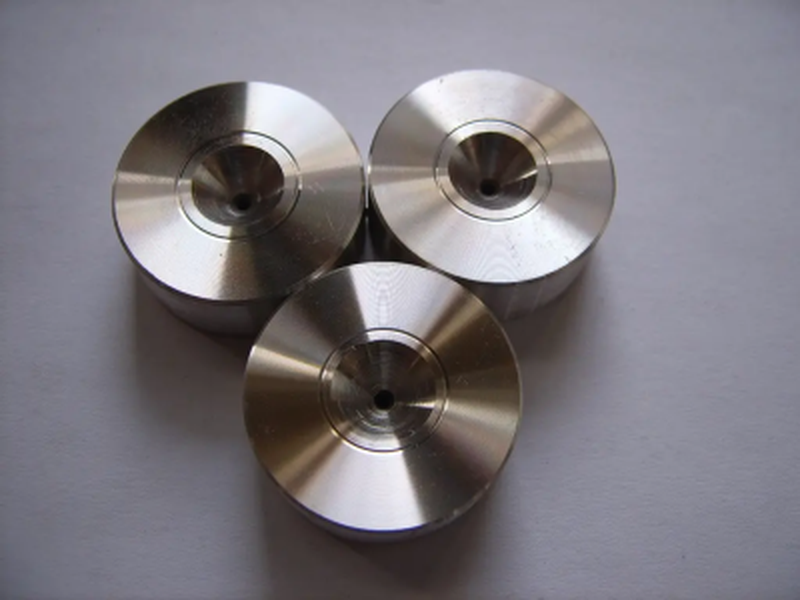
It is a wiredrawing die made of diamond for drawing fine wire of hard metals (such as tungsten). The hole of it has different diameter each side, its entrance is wide and its exit is small. A diamond drawing dies having high thermal conductivity is used for a wide range of applications such as copper wire and stainless steel wire. The dies are often used for creating ultra-fine wires that must meet strict dimensional precision or for drawing wire materials that require high surface quality.
Features of Diamond Wire Drawing Dies
Stable Dimension
The hole diameter of these diamond wire drawing dies changes very little during the processing of wire, allowing them to handle different materials and meet the tight dimensional tolerances required for ultra-fine wire.
High Temperature Resistance
The diamond content of these drawing dies makes them electrical insulators, creating inherent resistance to heat flow in high-temperature environments to avoid cracking.
Multi Sizes
Our diamond wire drawing dies are available in different specifications, ranging from 0.008mm to 30mm, suitable for flexible wires such as gold wire used in the semiconductor industry to rigid wires.
Smooth Surface
They are made of high-quality diamond raw materials and processed by melting, cooling and grinding to give them a smooth surface and uniform diameter.
Applications of Diamond Wire Drawing Dies
Industry Area
Diamond wire dies are used in the production of copper wire for electrical wiring applications, such as high-precision wires used in electronic devices, radar, television, instrumentation, aerospace, etc., as well as commonly used tungsten wire, molybdenum wire, stainless steel wire, wires and cables Wires and various alloy wires, etc.
Medical Devices
Diamond wire dies are used to produce fine wire used in medical applications such as catheters and stents. Its smooth surface finish of the wire reduces the risk of tissue damage.

Automotive
The dies are used to produce high-strength wires used in automotive applications such as brake cables and clutch wires. Especially the wire drawing dies made of natural diamond, because they use natural diamond as raw material, they have strong wear resistance and extremely high service life.
Jewelry Making
Diamond wire dies are used for producing fine gold and silver wires used in jewelry making, in various thicknesses and sizes.
Types of Diamond Wire Drawing Dies
Polycrystalline Diamond Wire Dies (Pcd Dies)
Polycrystalline diamond blanks as a base material can be successfully applied in almost any wire drawing operation, from rod-size to intermediate and fine size wires. The randomly oriented sintered diamond crystal structure makes these nib types stay round during use and its longevity is known to outperform both natural and synthetic single crystal diamond dies.
Typical Application Areas:
• Copper wire
• Aluminum wire
• Tungsten wire
• Molybdenum wire


Synthetic Single Crystal Diamond Wire Dies
Synthetic single crystal diamond has nearly the same material properties as natural diamond, therefore SSCD diamonds should be applicable in the same application areas as where natural diamonds are applied. Synthetic single crystal diamond dies are successfully applied in both ferrous and non-ferrous wire drawing industries. An advantage of SSCD drawing dies is that the blank dimensions are more consistent than natural diamond blanks, and therefore give a more predictable recut performance than natural diamond drawing dies.
Typical Application Areas:
• Bonding wire (gold, copper, aluminum)
• Medical wire
• Stainless steel wire
• Copper wire
Natural Diamond Wire Dies
SSCD and PCD blanks were invented in recent decades and are gradually replacing natural diamond dies in some applications. Natural diamond dies are still successfully used for applications that require excellent wire surface qualities, high heat resistance and in applications that require a die material that is not electrically conductive.
Typical Application Areas:
• Tungsten filament wire
• Bonding wire (gold, copper, aluminum)
• Medical wire
• Stainless steel wire
• Copper wire
• EDM wire

Process of Diamond Wire Drawing Dies
Choosing
Pick out colory natural diamond, the about 3-4 branch of weight.
Abrasive Drilling
On sharpening machine the natural diamond of selecting is ground two parallel planes, thickness is more than or equal to 0.65mm.
Edge Cover
Grind good natural diamond and be bumped in the stainless steel die sleeve that is added with metal powder, and cover cover plate then. Be sent to sintering in the hot pressed sintering machine again, natural diamond is fixed in the stainless steel die sleeve, obtain the roughcast cover. Position and the hardness of sintered body specification requirement that will reach regulation of natural diamond in stainless steel die sleeve behind the sintering.
Die Sleeve Is Handled
It is the processing of the roughcast cover being carried out successively car cover, mill cover, finish turning die sleeve end face that die sleeve is handled. At first will roughcast cover send to lathe and carry out the processing of car cover through sintering, and go out an import conical cavity and an outlet conical cavity at two cars of die sleeve, die sleeve with car after good is delivered to and is ground cover on the coreless grinding machine and handle, and is milled to the technological requirement of cylindrical to regulation. At last, again die sleeve two faces are carried out finish turning and handle, and make the awl bottom surface consistent.
Laser Boring
Laser drilling process is that a hemispheric pit is got by elder generation on the plane in the exit of natural diamond. The molding hole, position that on the plane of diamond import department, faces toward then with hemispherical, the place, arc top of the nib lucky break-through hemispherical dimples of getting.
Moulding
Moulding process is the requirement that the nib of getting is machined to the finished product regulation on ultrasonic wave grinder and line polisher, on the position of the plane, porch of die sleeve regulation, stamp trade mark, specification then, stamp the making numbering, pack then, put in storage in the position of plane, exit regulation.
What You Should Know When Use Diamond Wire Drawing Dies?
Deformation of wire as well as friction between wire and die generate heat, which increases with increasing drawing speeds and higher reduction. Temperature rise of 60 – 80 degree Celsius for mild steel and 100 – 150 degree Celsius for high carbon wire per draft is normally encountered. Various techniques are adopted to dissipate this heat and cool the wire between two passes.
It must be ensured that water does not seep into the lubricant or die which may lead to lumping of lubricant and reduce its flow into die. While starting drawing operation, flow of running water is gradually increased as the die temperature rises and then continuous flow maintained.
Lubricant powder in die box be stirred regularly for which lube stirrers can be employed, if necessary.
Bearing length (especially for first draft) of die be reduced to 75% of that used for pickled/ coated wire rod. Percentage area reduction in the first pass be reduced by about 25% of normal practice for pickled wire rod. It may also be noted that die life is likely to be reduced by 5 to 10% (more in the first pass) depending upon the quality of descaling and lubrication.
It is advisable to clean and service the dies at regular interval, as decided by experience and use in the company. Since defective wire coming out of one die will affect performance of all subsequent dies, it is suggested that complete set of dies be changed rather than changing one die, this will also reduce machine downtime if dies are changed as and when worn.
In industry preventive maintenance rather than breakdown maintenance, is common practice similarly for best performance in wire mill preventive change of dies rather than breakdown changing of dies be followed. In technically advanced wire drawing units, whole set of dies are changed at regular intervals (determined by experience and past records) rather than waiting for any defects to develop in wire or die.
Certificate Photo

Our Factory Photo

Frequently Asked Questions of Diamond Wire Drawing Die
Q: Can diamond be used as dies for drawing wires?
Q: What are diamond dies?
Q: What are the dies of drawing wire?
Q: How is diamond wire die used?
Q: What are the benefits of using diamond wire dies in wire drawing processes?
Reduces manufacturing costs such as die replacement and improves production efficiency.
Q: How are diamond wire dies different from other types of wire dies?
Q: What is the die angle in wire drawing?
Q: What are the features of PCD diamond wire dies?
Q: What materials are used to make diamond wire dies and how are they manufactured?
Q: Can diamond be used as dies for drawing wires?
Q: What is the lifespan of a diamond wire die?
Q: What is diamond's Life?
Q: What are the common problems that can occur when using diamond wire dies?
Q: Are diamond wires dies unbreakable?
Q: What are the maintenance requirements for diamond wire dies?
Q: How are diamond wire dies cleaned and what cleaning agents or methods are recommended?
Q: Why diamond is used for cutting?
Q: What industries commonly use diamond wire dies and what wire drawing applications are they used for?
Q: What product are diamond dies used for?
We're well-known as one of the leading diamond wire drawing dies manufacturers and suppliers in China. Please rest assured to wholesale high quality diamond wire drawing dies at competitive price from our factory. Contact us for customized service.
